|
|
|
 The
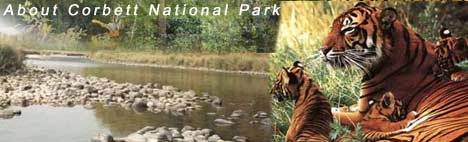
Corbett National Park Tourism The
Corbett National Park Tourism :
Largest Tiger Populated Reserve In The World
is first national park of India established
in the year 1936 it was named Hailey
National Park. In 1957, the park was rechristned
as the Corbett National Park in the memory
of Late Jim Corbett great naturalist.eminent
conservationist.
Corbett National
Park Location & Area
Corbett national park
is a paradise for wildlife enthusiasts,
is known to house a population of 200
+ tigers along a massive topographical area
interspersed with hilly ridges and rolling
grasslands in the foothills of Himalayas
and spreads over an area of 520 sq. kms.,
along the bank of Ramganga river. The dense
Sal forests of Himalayan foothills and the
tall grassy meadows make it one of the richest
areas of northern India for the habitation
of big mammals.
The Corbett national park covering an area
of 521 Sq. Kms. is situated at the foothills
of the Himalayas. It spreads over parts
of two districts, a major part of park with
an area of 312.86 sq. Kms. falls in Pauri
Garhwal district and the balance 208.14
sq. Kms. in Nainital district. The park
occupies portions of Kalagarh and Ramnagar
forest divisions. It falls within the trek
of land known as Paltidun.
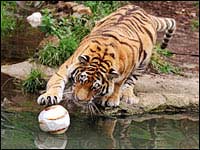
Following international appeal to save the
world's most magnificent beasts, Project
Tiger was launched with the help of
World Wildlife Fund on April 1st 1973, making
the Corbett National Park a heaven for the
tigers.
 |
|
The lake in the park attracts a large
number of species of water birds,
both migrants and others, that frequent
it's water, mainly in the winter.
Among the reptiles, the long snouted,
fish eating gharial and mugger (crocodiles)
could be seen basking in the sun on
the sand banks.
Sporting fish such as mahseer and
malee thrive in the lake and in the
river, offering great fishing, sport
to anglers. |
Different species
of trees, shrubs, bamboo and grass make
up the lush vegetation of the park. The
sanctuary is dominated by pure sal, for
which the park is known.
It is found in the lower hilly ridges and
flat valleys while the soothing green shisham
is in abundance in the revering area. The
balky enriches the hues of park with its
reddish leaves and pale bark and the the
chaurs, the savannah grasslands are covered
with a variety of grass. During the monsoon
from June to October, the park remains closed
to tourists and the animals move to the
hilly areas of Corbett at this time.
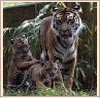
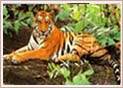 The Tiger is the bigger attraction
of this park. Other carnivores include the
leopard, elephant, bear, hog, sambar deer,
muntjac and fox. The park has more than
300 species of birds. The common birds seen
here are ducks snipe egrets, herons, spotted
eagle, harrier, woodpecker, darter, cormorants
and thrushes.
The Tiger is the bigger attraction
of this park. Other carnivores include the
leopard, elephant, bear, hog, sambar deer,
muntjac and fox. The park has more than
300 species of birds. The common birds seen
here are ducks snipe egrets, herons, spotted
eagle, harrier, woodpecker, darter, cormorants
and thrushes.
The Ramganga is the home of the prehistoric
reptiles, gharial and the mugger. The gharial
has been saved from extinction in the park
through captive breeding. A few species
of turtles and tortoises are also found
in and around lake. The chital and the well
known spotted deer, considered to be one
of the most beautiful in the world congregate
in large numbers in the vast grassland choirs
of Corbett.
|
|
|
|
|